Platform review
AxiaFunder Review: Returns and Risks
How litigation funding works, what the public track record shows, and the fees, minimum investment, and risks to understand before committing money.
The short version
The short version
- What it isAxiaFunder is a UK litigation-funding platform. Investors provide capital for commercial cases or portfolios of claims and receive a return only if the underlying investment produces sufficient proceeds.
- Headline offerThe platform currently presents a £1,000 minimum investment. Its public materials discuss modelled returns around 20–30% per year, while recent housing-disrepair (HDR) portfolio offers have commonly shown expected returns around 19–21% per year, net of AxiaFunder's fees.
- What stands outAxiaFunder publishes capital raised, funded claims, repayments and returns for all resolved claims and tranches, including failed outcomes, with a breakdown by law firm. Published track-record returns are net of AxiaFunder's fees.
- What matters mostThis is not fixed income. Returns and timing depend on legal outcomes, law-firm performance, case replacement, insurance and recovery. Investments are illiquid and losses can be substantial.
- My viewAxiaFunder is an interesting specialist platform for eligible experienced investors, but I would treat it as a small alternative allocation rather than a core income holding.
AxiaFunder offers something genuinely different from the P2P loans and property-backed crowdfunding platforms I usually review. Instead of lending to consumers, businesses or property developers, investors finance legal claims and portfolios of litigation.
That difference is the attraction and the risk. Legal outcomes are not driven by interest rates or stock-market sentiment in the same way as listed assets, so litigation funding can add diversification. But it is also difficult to analyse, highly illiquid and dependent on several parties doing their jobs over an uncertain period.
My conclusion is balanced: AxiaFunder is one of the more transparent ways I have seen to explore litigation funding, but the potential return should never be separated from the possibility of long delays and serious losses.
AxiaFunder homepage, captured on 9 September 2026, showing the litigation-funding introduction and prominent high-risk warning.
This is an independent editorial review based on AxiaFunder's public website, legal documents, risk disclosures and track-record data available on 26 August 2026. It contains no affiliate link or lead form. I have not completed a full investment-and-repayment cycle through AxiaFunder, so the figures discussed below are platform data rather than personal investment results.
Updated on 9 September 2026 to incorporate factual clarifications supplied in feedback on the review. The dated August track-record figures below have been retained.
What litigation funding is
Litigation funding provides money to pursue legal claims. The funded party may need capital for lawyers, court costs, expert evidence, disbursements or the operating costs involved in bringing a case to settlement or judgment.
The investor is not normally receiving a conventional loan repayment from predictable business cash flow. The economic return depends on the structure described in the offer document and, ultimately, on whether claims resolve successfully and produce enough money to cover the agreed distributions.
AxiaFunder offers both individual commercial litigation investments and portfolio structures. A portfolio can spread capital across many claims rather than relying on one court case, but it introduces other risks such as the quality of the originating law firm, replacement assumptions and the operational management of a large claims book.
The supposed lack of correlation with public markets is useful, but it should not be interpreted as low risk. Litigation has its own risk cycle, and case outcomes can be binary, delayed and expensive.
What AxiaFunder is
AxiaFunder is a trading name of Champerty Limited, a UK company with Financial Conduct Authority reference number 968527. AxiaFunder's investor terms state that Champerty Limited is authorised and regulated by the FCA.
The platform connects eligible investors with funding partnerships created to fund litigation cases or portfolios. All current offers use Scottish limited partnerships, with investors holding limited-partnership interests. These funding partnerships are themselves the issuers. Bonds and equity were used historically. Investors should still read the relevant information memorandum to understand the terms and risks of each opportunity.
AxiaFunder conducts its own screening before publishing an opportunity. For portfolio cases, it says it monitors progress using case information and regular reporting. Investors receive updates during the investment lifecycle, but monitoring cannot remove the underlying legal, counterparty and timing risks.
AxiaFunder at a glance
- Asset class: Commercial and portfolio litigation funding
- Operator: Champerty Limited
- FCA reference: 968527
- Current investment structure: Scottish limited partnerships; investors hold limited-partnership interests
- Minimum investment: £1,000 per opportunity
- Typical advertised expectation: Often around 19–21% p.a. on recent HDR portfolio offers, net of AxiaFunder's fees
- Broader model assumptions: Approximately 20–30% p.a. in AxiaFunder's FAQ
- Duration: Opportunity-specific and often measured in years
- Liquidity: Limited and not guaranteed
- Eligible investors: Professional, high-net-worth and self-certified sophisticated investors
- FSCS protection: No protection against investment-performance losses
The return figures above are expectations and model outputs, not contractual guarantees. They should be understood alongside the platform's own warning that an investor can lose all the money invested.
How investing works
The broad process is:
- Register and complete identity verification.
- Confirm that you belong to an eligible investor category.
- Complete the platform's knowledge and appropriateness checks.
- Review the available opportunity and its information memorandum.
- Invest at least £1,000 if the structure and risks are acceptable.
- Receive updates while cases progress.
- Receive distributions if and when the underlying investment generates proceeds.
The offer document is the decisive source. It should explain what security or interest the investor owns, the use of funds, expected duration, distribution waterfall, fees, case-replacement provisions, insurance and the risks specific to that investment.
I would not invest based only on an expected annual return. For every offer, I would want to understand:
- how many claims are included;
- which law firm is responsible for them;
- how claims were selected and valued;
- what proportion may need to be replaced;
- whether the economics accrue over time or depend on specific outcomes;
- what ATE insurance covers and excludes;
- what happens if the law firm or insurer fails;
- how investor proceeds rank against other claims and fees.
What the platform currently funds
The public homepage recently showed funded portfolios of UK housing-disrepair claims. These offers finance disbursements for groups of claims pursued by specialist law firms. The stated model includes replacing unsuccessful claims in accordance with the relevant offer terms.
Recent public HDR portfolio examples have shown expected returns around 19–21% per year, net of AxiaFunder's fees, with principal and gains expected to be distributed gradually over periods such as 9–30 or 12–30 months. Those periods are projections rather than fixed repayment dates. Current HDR portfolio offers use the same return methodology.
HDR portfolio repayments are structured in 10 tranches, triggered as successive 10% portions of the portfolio's cases settle. The first tranche is triggered when 10% of cases settle, the next when a further 10% settle, and so on. These are settlement milestones, not scheduled payment dates; the timing remains uncertain.
Portfolio funding reduces dependence on a single legal case, but it creates concentration at another level. HDR portfolios contain claims against many different councils, while claims can still be concentrated in the same law firm and claim category. I would therefore assess diversification across law firms and claim categories as well as the number of claims.
AxiaFunder has also funded individual commercial disputes. These can offer a clearer link between one case and one potential recovery, but the result may be more binary and the time to resolution more uncertain.
Returns and public track record
The quality of AxiaFunder's public reporting is one of the strongest parts of the platform.
Its track-record page, updated on 3 August 2026, reported £32,689,440 raised across commercial and portfolio investments. When I checked the homepage later in August, its counters showed approximately £33.1 million raised across 102 funded offers.
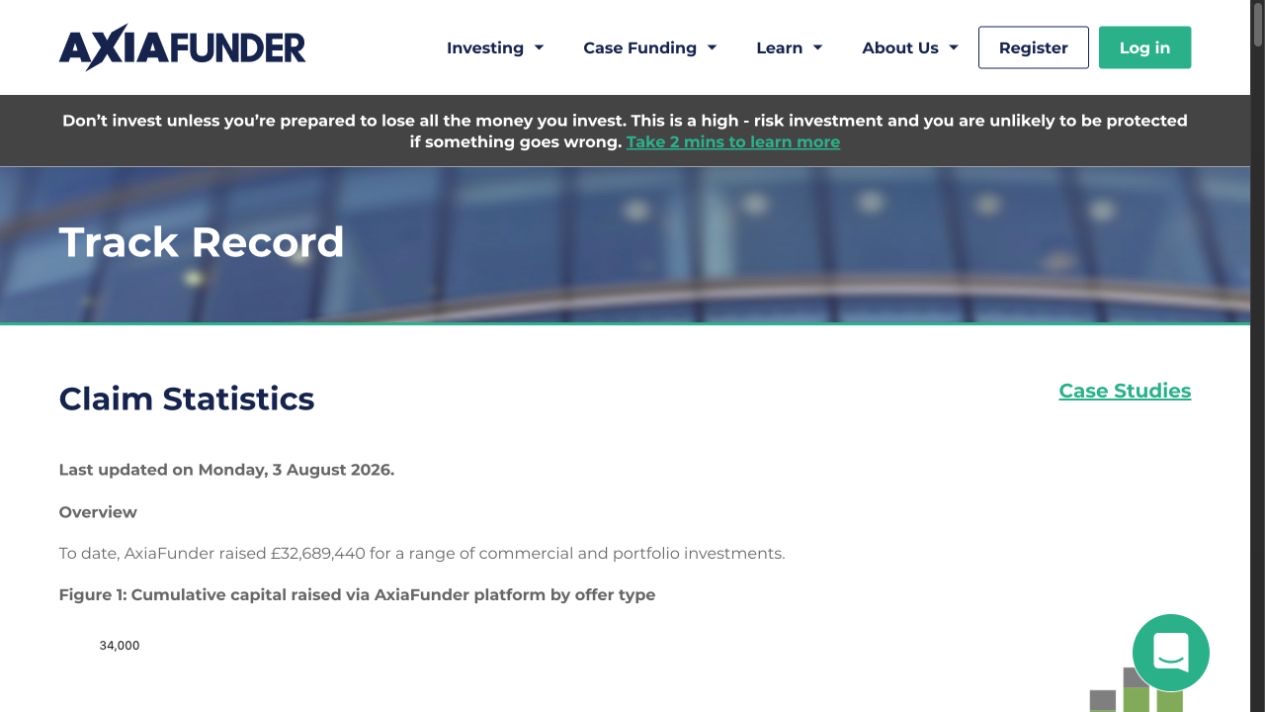
The public track-record section provides dated capital and claim statistics rather than relying only on a headline return.
For housing-disrepair portfolios, the August track-record update reported:
- £27.27 million funded;
- 71 separate limited-partnership SPVs;
- 10,546 claims funded;
- 3,584 claims repaid at that point.
The page publishes returns for all resolved claims and tranches, including failed outcomes, with a breakdown by law firm. These published track-record returns are net of AxiaFunder's fees. The law-firm breakdown reports average annualised IRRs ranging from the mid-teens to above 20%, depending on the law firm and tranche set.
That data is useful, but it needs careful interpretation:
- results cover all resolved claims and tranches, including failed outcomes, while unresolved claims remain outstanding;
- current HDR portfolio offers use the same return methodology, allowing comparison across the law-firm breakdown;
- IRR is sensitive to the timing of cash flows;
- a profitable tranche does not predict the outcome of a new offer;
- platform-level averages can hide weak counterparties.
The same track-record page reports that one funded law firm entered administration in July 2024 and that investors in the related SPVs recovered invested capital only. I see this disclosure as a positive sign of transparency, but it is also a concrete example of counterparty risk reducing expected returns.
Minimum investment, duration and liquidity
The current minimum is £1,000 per investment. That is manageable for testing one opportunity, but meaningful diversification requires considerably more capital. Ten equally sized positions would already require £10,000.
Duration is not fixed in the way it is for a term deposit or a listed bond. Offers may provide a target period, but legal proceedings can take longer than expected. HDR portfolios repay in 10 tranches as successive 10% portions of their cases settle. The timing of each milestone is uncertain, and cases can be delayed by courts, defendants, evidence, insurers or the funded law firm.
AxiaFunder operates a secondary-market facility for investments that it permits to be traded. This should be treated as a possible exit mechanism, not a promise of liquidity. A sale requires an eligible buyer and remains subject to platform and pricing constraints.
My practical assumption would be that every investment must be held until its underlying cases resolve, even if that takes several years.
Fees and investment economics
AxiaFunder's investor terms describe a success fee of 20% of net litigation proceeds before SPV-related operating costs are deducted. The information memorandum should explain the complete distribution waterfall and applicable costs.
Published track-record returns and the advertised 19–21% annual HDR returns are already net of AxiaFunder's fees. Investors should not deduct the success fee again from those figures. The advertised returns remain forecasts, and actual outcomes depend on case results and the timing of distributions.
ATE insurance premiums are paid by the claimant, rather than treated as investor or SPV costs. When reviewing the investment economics, I would examine:
- the SPV-related operating costs and other expenses described in the information memorandum;
- the timing of distributions;
- the replacement of unsuccessful claims;
- the distribution waterfall and profit-sharing terms.
Current HDR portfolio offers use the same return methodology. The relevant comparison is the investor's net cash flows and how long the capital remains outstanding, alongside the underlying risks.
Regulation and investor eligibility
AxiaFunder is a trading name of FCA-authorised Champerty Limited. Regulation is relevant because it creates obligations around conduct, communications and platform operations. It is not a guarantee that an investment will succeed.
The platform's investments are intended for:
- professional investors;
- certified high-net-worth investors;
- self-certified sophisticated investors.
The current UK high-net-worth statement uses an annual-income threshold of £100,000 or qualifying net assets of £250,000. The sophisticated-investor criteria include relevant professional experience, qualifying company directorship, repeated unlisted-company investing or membership of a business-angel network.
Meeting one of these definitions does not make litigation funding suitable. It only determines whether the investor can receive and act on the relevant financial promotion.
The main risks
AxiaFunder correctly describes these investments as complex and high risk.
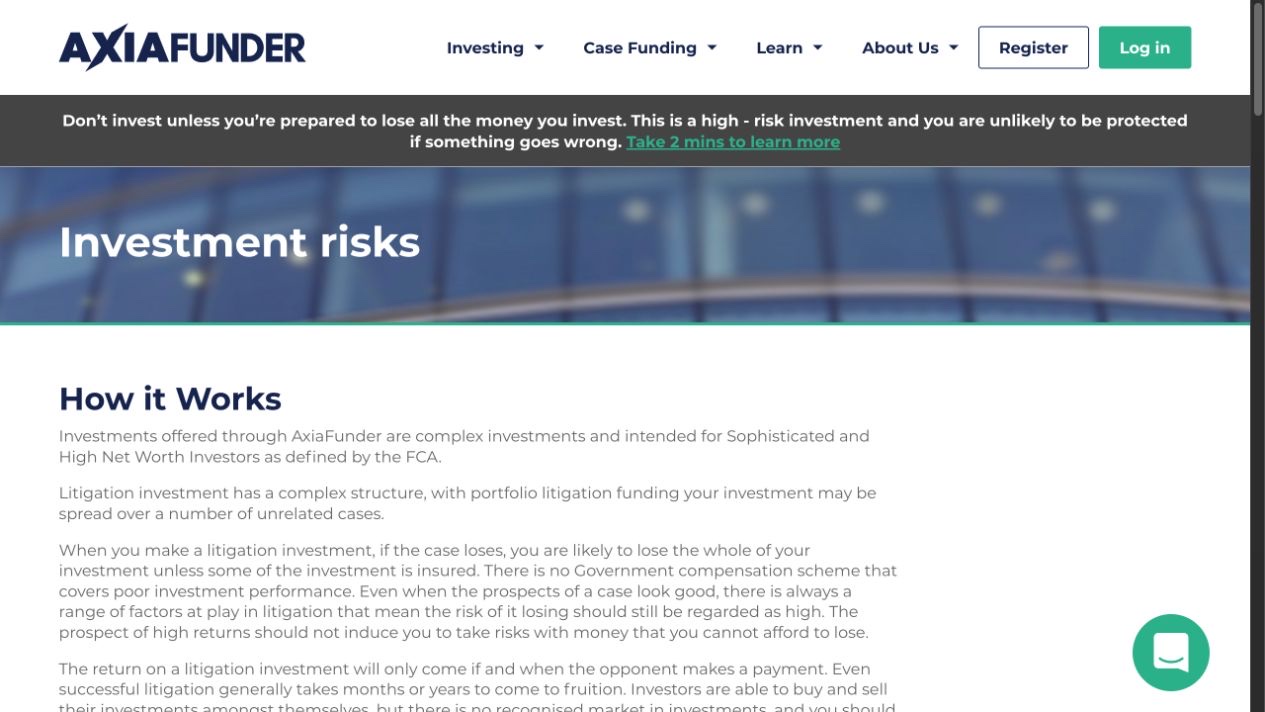
The platform states clearly that returns depend on successful outcomes and that investments are intended for sophisticated and high-net-worth investors.
Total loss
If cases fail or the investment structure does not generate enough proceeds, investors can lose the entire amount committed.
Losses beyond the initial investment
AxiaFunder's risk disclosure says that, in remote circumstances, adverse-cost exposure could result in losses exceeding the original investment. ATE insurance is intended to mitigate this risk where applicable, but cover may be invalidated by a breach of the policy's terms and conditions. An insurer can also become insolvent.
Law-firm and counterparty risk
Even a strong set of claims can be impaired if the funded law firm experiences financial or operational problems. The funding partnerships themselves are the issuers; insurers and service providers add further dependencies.
Duration risk
Court timetables and settlement negotiations are unpredictable. Capital can remain committed well beyond the initial forecast, reducing the annualised return even when the nominal investment eventually succeeds.
Liquidity risk
There is no recognised exchange for these investments. The secondary market may be unavailable or lack buyers when an investor wants to exit.
Concentration risk
A portfolio can contain many claims while remaining concentrated in one law firm or claim category. HDR portfolios include claims against many different councils, but that does not remove law-firm and claim-category concentration. Counting claims alone can overstate diversification.
Model risk
Expected returns depend on assumptions about success rates, case replacement, settlement values, costs and timing. Small changes in those assumptions can materially alter the result.
What I like
The strongest qualities are:
- A differentiated asset class: litigation funding can behave differently from equities, bonds and ordinary private credit.
- Detailed public reporting: the platform publishes capital raised, claims funded, repayments and returns for all resolved claims and tranches, including failed outcomes, with a breakdown by law firm. Published returns are net of AxiaFunder's fees.
- Visible risk warnings: the possibility of losing capital is not hidden in small print.
- Offer-level documentation: investors can examine the specific structure rather than buying a generic pooled product.
- Portfolio opportunities: spreading capital over many claims can reduce dependence on one legal result.
- Regulated operator: FCA authorisation is a stronger operational starting point than an unregulated investment website.
I particularly value the inclusion of weaker outcomes in the track record. A credible review needs to show what happens when a law firm fails, not only the best-performing tranches.
What to keep in mind
AxiaFunder remains a specialist platform. Analysing a litigation portfolio requires more than comparing an interest rate and maturity date.
The £1,000 minimum also makes diversification expensive. I would not want one litigation investment to represent a significant share of a portfolio, yet building ten or twenty positions requires substantial capital and a continuing supply of suitable offers.
The track record is informative but still evolving. Many claims remain unresolved, and the final economics of an SPV can look different from the early repaid tranches.
Finally, there is a difference between a high modelled return and dependable passive income. Litigation proceeds can arrive irregularly and later than expected. I would not use them to fund recurring living expenses or near-term financial commitments.
Who AxiaFunder is for
AxiaFunder may be worth researching for an investor who:
- meets the required UK investor classification;
- understands private, illiquid and potentially complex investments;
- can read an information memorandum critically;
- can hold capital for several years;
- already has a diversified core portfolio;
- wants a deliberately small allocation to an alternative return source;
- can tolerate losing the full allocation.
It is not suitable for emergency savings, short-term money, beginners seeking predictable income, or anyone who needs FSCS-style protection and daily liquidity.
Pros and cons
What works well
- Provides direct access to a specialist alternative asset class
- Public track record covers all resolved claims and tranches, including failed outcomes, with a law-firm breakdown
- Recent portfolio offers spread exposure across multiple legal claims
- FCA-authorised operator with clear eligibility requirements
- Prominent risk disclosures and opportunity-specific documents
- Potential returns are not closely linked to daily public-market movements
What to consider
- Complex investments with a real possibility of total loss
- In exceptional circumstances, adverse-cost exposure may exceed the initial investment
- £1,000 minimum makes broad diversification capital intensive
- Investment duration is uncertain and can extend for years
- Secondary-market liquidity is limited and cannot be assumed
- Returns depend on law firms, insurers, legal outcomes and model assumptions
FAQ
Is AxiaFunder regulated?+
What is the minimum AxiaFunder investment?+
What returns does AxiaFunder offer?+
How long does an AxiaFunder investment last?+
Can I sell an AxiaFunder investment early?+
Can I lose more than I invest?+
Who can invest through AxiaFunder?+
Is AxiaFunder covered by the FSCS?+
Verdict
AxiaFunder is a credible and unusually transparent entry point into litigation funding. The platform provides substantial public track-record information, clear opportunity documents and access to an asset class that can diversify a conventional portfolio.
The trade-off is equally clear. Litigation funding is complex, illiquid and outcome-dependent. The expected returns are high because investors accept risks that do not exist in a savings account, ETF or ordinary investment-grade bond.
For an eligible experienced investor, I can see a case for a small, diversified allocation after studying each offer document and accepting that the money may remain locked up for years. I would not treat the projected return as predictable income, and I would never make AxiaFunder a core holding.
That is ultimately how I view the platform: interesting, transparent and potentially rewarding, but only for investors who understand exactly why the return is available and can absorb a poor outcome.

Thanks for reading.
Explore more of my experience with investing and building passive income.
Inside my portfolioKeep reading
LEI System’s prices, application and renewal terms, with a practical look at which plan suits your company.
Compare plans, currency tools, team cards, and integrations, with a closer look at the charges European businesses need to factor into their decision.
A closer look at mortgage-backed projects, target returns, minimum investment, regulation, and the risks involved in lending through this real estate platform.
Explore the loan types, governance, target returns, and loyalty programme, alongside the uncertainties that come with investing through a newer lending platform.
My experience with Romanian property lending, covering collateral, minimum investment, investor fees, target returns, and the risks behind the platform’s projects.
My investing results, how the buyback structure works, and what the platform’s licensing means when weighing it alongside other European lending options.