Platform review
Digilo Review: Property Lending and Risks
A closer look at mortgage-backed projects, target returns, minimum investment, regulation, and the risks involved in lending through this real estate platform.
This article contains affiliate links. How this site is funded
The short version
The short version
- What it isA Latvian European crowdfunding platform connecting investors with business loans secured by real estate. Digilo operates under the EU crowdfunding framework and is supervised by Latvijas Banka.
- Headline offerThe platform advertises expected annual returns of 9–12%, loan terms generally ranging from 12 to 36 months and a €150 minimum investment per project.
- What stands outThe combination of ECSP authorisation, real-estate collateral and clearly displayed LTV, term, interest and risk metrics makes the proposition easy to evaluate.
- What to keep in mindDigilo is still building its public repayment record. Property security can improve recovery prospects, but it does not guarantee repayment or make the investment liquid.
- Would I use it?Yes, as a small satellite allocation spread across several loans. I would start with the minimum, review every project document and increase only after seeing repayments and completing a withdrawal.
Digilo is one of the more interesting new entrants in European real-estate crowdfunding. The basic proposition is straightforward: investors fund loans to businesses and self-employed borrowers, the loans are backed by property, and each project displays an interest rate, term, loan-to-value ratio and risk category.
The homepage currently presents a €150 minimum investment, expected annual returns of 9–12%, and typical terms of 12–36 months. Those are attractive figures, but they are targets rather than guaranteed results. The quality of the borrower, valuation of the collateral and repayment structure matter more than the headline rate.

Digilo presents the core offer clearly: mortgage-backed opportunities, a €150 entry point, 9–12% expected annual returns and 12–36 month terms.
This review is based on the platform, its public documentation and a detailed walkthrough of the investment interface. I have not yet completed a full investment-and-withdrawal cycle, so I am not presenting the advertised return as a personal result.
What Digilo is
Digilo is operated by CSP Growth Solutions SIA, registration number 40203585248. Latvijas Banka authorised the company as a European crowdfunding service provider on 16 September 2025. The authorisation covers the facilitation of business loans and related services such as individual portfolio management, a bulletin board and credit scoring for crowdfunding projects.
That regulatory foundation matters. Digilo is not simply a website introducing borrowers and investors; it operates within Regulation (EU) 2020/1503, usually called the ECSP or ECSPR framework. This brings requirements around governance, project information, investor classification, suitability checks and risk warnings.
The team also presents a longer operating background than the public platform itself. Digilo says its experience includes real estate since 2008, property-backed business loans since 2009, licensed consumer mortgage lending since 2016 and licensed credit brokerage since 2023.

The platform is new, but the team presents experience in real estate, secured business lending, mortgage lending and credit brokerage.
This is an important distinction. A young marketplace does not automatically mean an inexperienced lending team. At the same time, experience in originating and managing loans is not the same as a long public record of investor repayments through Digilo. Both facts belong in the assessment.
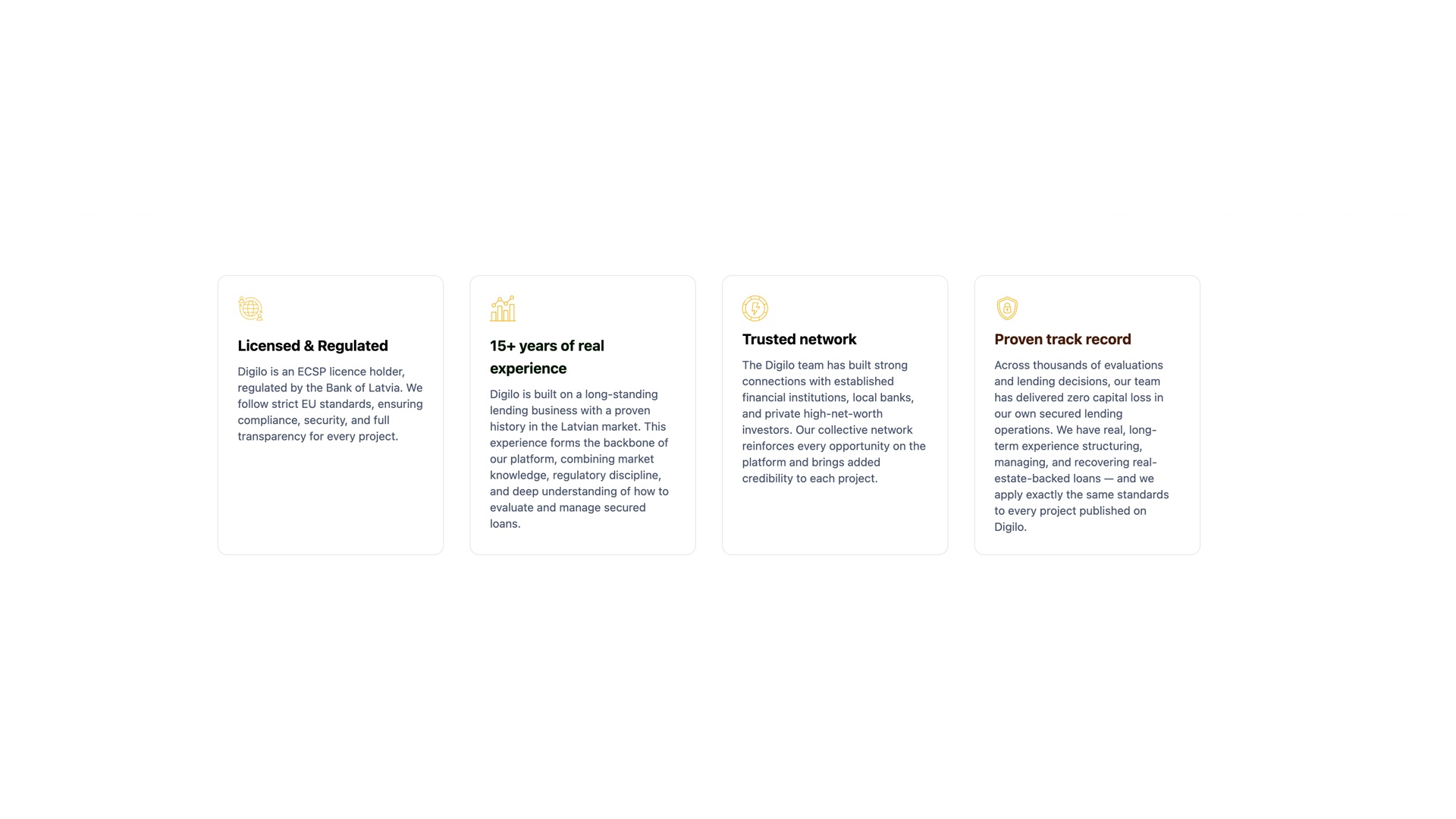
Digilo's credibility case combines ECSP authorisation, lending experience, an established network and previous secured-lending activity.
How investing works
The investment flow is familiar if you have used EstateGuru, Profitus or another European crowdfunding marketplace:
- Create an account and complete identity verification.
- Transfer euros to the payment account connected to your profile.
- Review the available projects and their documents.
- Choose an amount, starting from €150 for manual investments.
- Receive interest and principal according to the project's repayment schedule.
Digilo uses Lemonway, a regulated European payment institution, for payment services. This separates payment handling from the platform's ordinary operating account and supports the identity and anti-money-laundering checks required during onboarding.
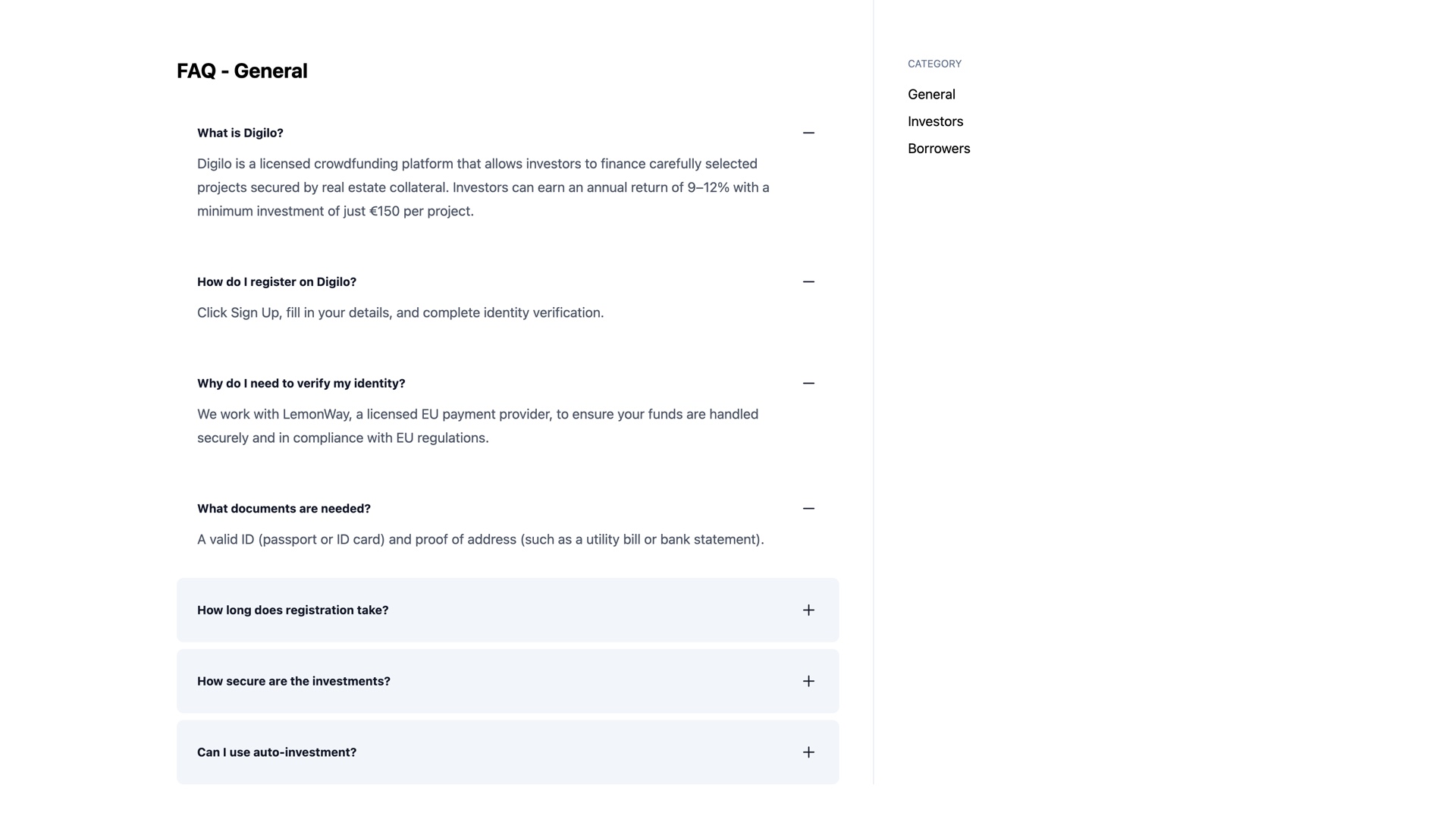
Registration includes identity verification and normally requires an identity document and proof of address.
The public project list is concise. It displays the country, requested amount, LTV, interest rate, term, risk label, funding progress, investor count and time remaining. This is enough to compare opportunities quickly without reducing the decision to interest rate alone.

The marketplace exposes the metrics I want to see before opening a project: amount, LTV, rate, term, risk and funding progress.
A real project walkthrough
The screenshots used for this review captured a Latvian project requesting €33,045.23. It displayed a 12% interest rate, 36-month term, 52% LTV, a low platform risk category and a balloon repayment schedule.
The collateral value shown was €63,000. Dividing the loan amount by that valuation produces roughly the displayed 52% LTV. On paper, that leaves a meaningful valuation cushion. In practice, the quality of the cushion depends on whether the valuation is current, independent and achievable in a forced sale after legal and recovery costs.
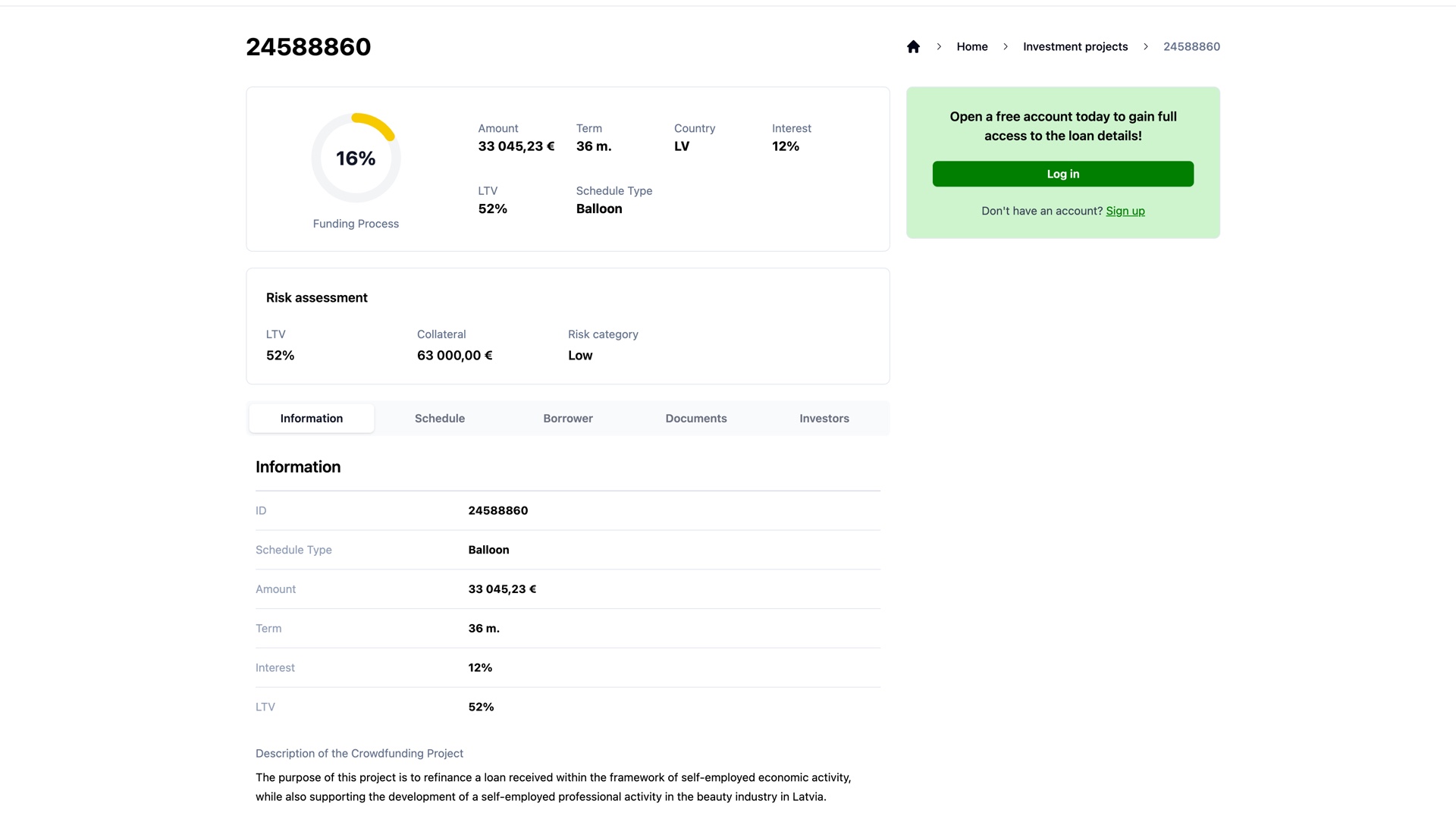
This captured example combined a 12% rate with 52% LTV and €63,000 of stated collateral. It should be treated as an illustration, not a current recommendation.
The project also used a balloon schedule. This normally means regular interest payments with a large principal repayment at maturity. Balloon loans can work well when a borrower has a credible sale, refinancing or operating-cash-flow plan. They also concentrate refinancing risk at the end of the term, so the repayment source deserves careful attention.
Before investing in a Digilo project, I would answer five questions:
- What exactly is pledged as collateral, and what rank does the security have?
- Who produced the valuation, and how conservative is it?
- What is the borrower's financial position and operating history?
- Where will the money for interest and final principal repayment come from?
- What recovery process applies if the borrower is late or defaults?
The project filters encourage that more disciplined approach. Investors can screen by risk level, LTV, term and interest rate instead of simply selecting the highest yield.
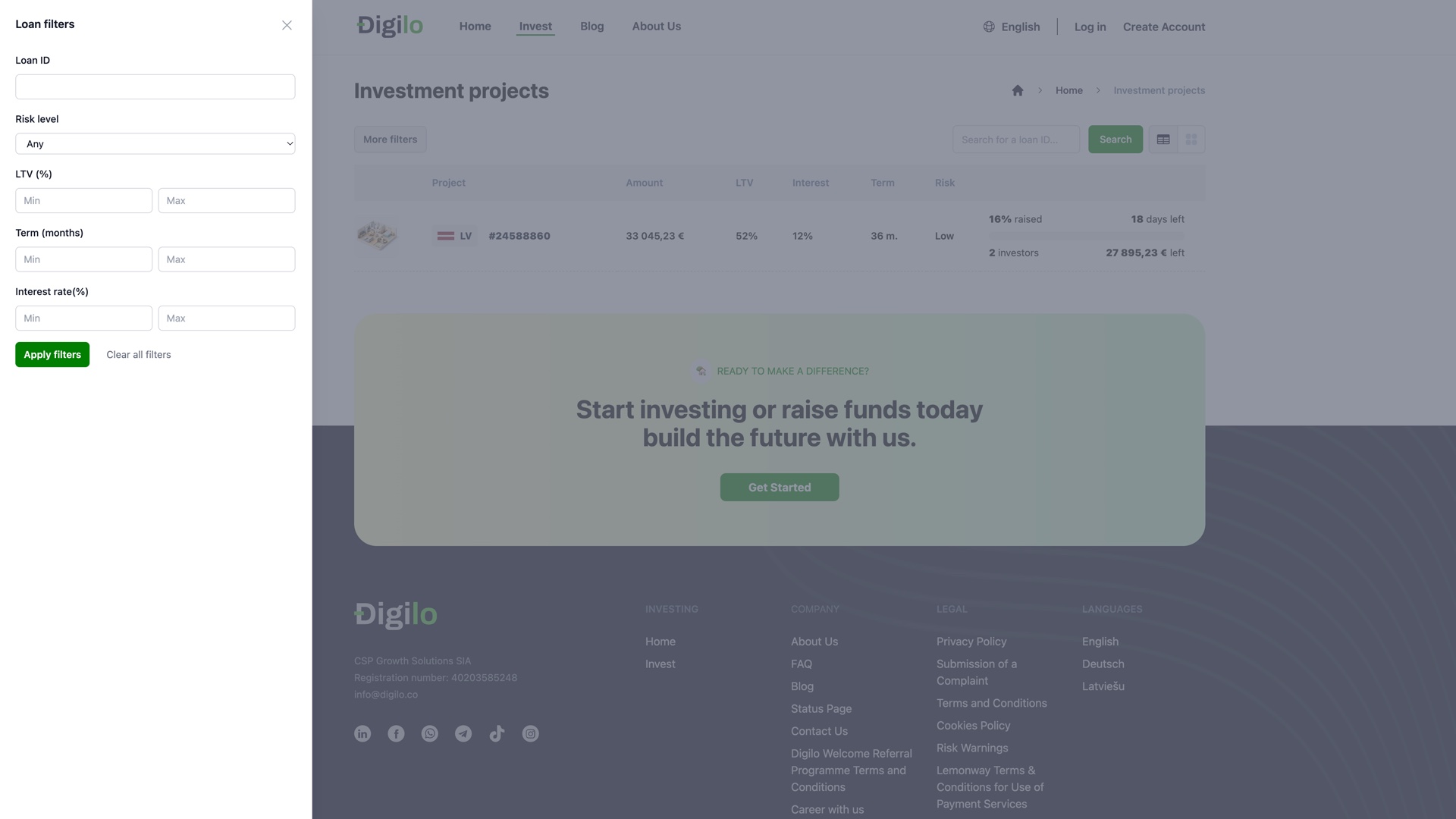
Filtering by LTV, duration and risk is more useful than sorting only by headline return.
Returns, terms and minimum investment
Digilo says expected annual returns generally range from 9% to 12%, depending on the project. Each listing sets its own rate, duration and repayment schedule. The platform's public materials describe typical loan terms of 12 to 36 months.
The minimum manual investment is €150 per project. That is low enough to build diversification gradually: €1,500 could theoretically be spread across ten projects rather than concentrated in one loan. Whether that level of diversification is immediately available depends on the number and variety of live projects.
Interest should be evaluated together with LTV and duration. A 12% project at 52% LTV is not automatically better than a 10% project at 45% LTV. The borrower, collateral type, security rank, cash flow and exit plan may justify a lower or higher rate.
My practical rule is simple: compare loans using the base contractual rate, assume some cash drag between projects, and never build a financial plan around the maximum advertised return.
Is Digilo safe?
No crowdfunding investment is safe in the sense of a guaranteed bank deposit. Digilo has several structural strengths, but investors can still lose money.
ECSP authorisation
Digilo's operator is authorised and supervised by Latvijas Banka as a European crowdfunding service provider. This is a meaningful positive because it creates formal obligations around project disclosures, investor protection processes and platform governance.
It does not guarantee a loan. The regulator does not repay investors when a borrower defaults, and authorisation should not be confused with deposit insurance.
Real-estate collateral
Digilo states that its projects are backed by real estate and that LTV does not exceed 60%. A conservative LTV can improve the chance of recovery because the collateral is worth more than the loan on the initial valuation.
But collateral is a recovery mechanism, not a repayment guarantee. Property values can fall, valuations can prove optimistic, legal enforcement can take time, and sale proceeds must absorb costs before reaching investors. Even a low-LTV loan can produce a delay or loss if the security is difficult to enforce.
Payment handling
Lemonway handles payment services and investor onboarding checks. That is preferable to investor cash moving directly through an ordinary platform bank account. It reduces one operational risk but does not protect money already committed to a borrower.
No deposit guarantee
Digilo's own risk warning states that crowdfunding investments can result in partial or total loss. They are not deposit products and are not covered by the EU deposit-guarantee or investor-compensation schemes.
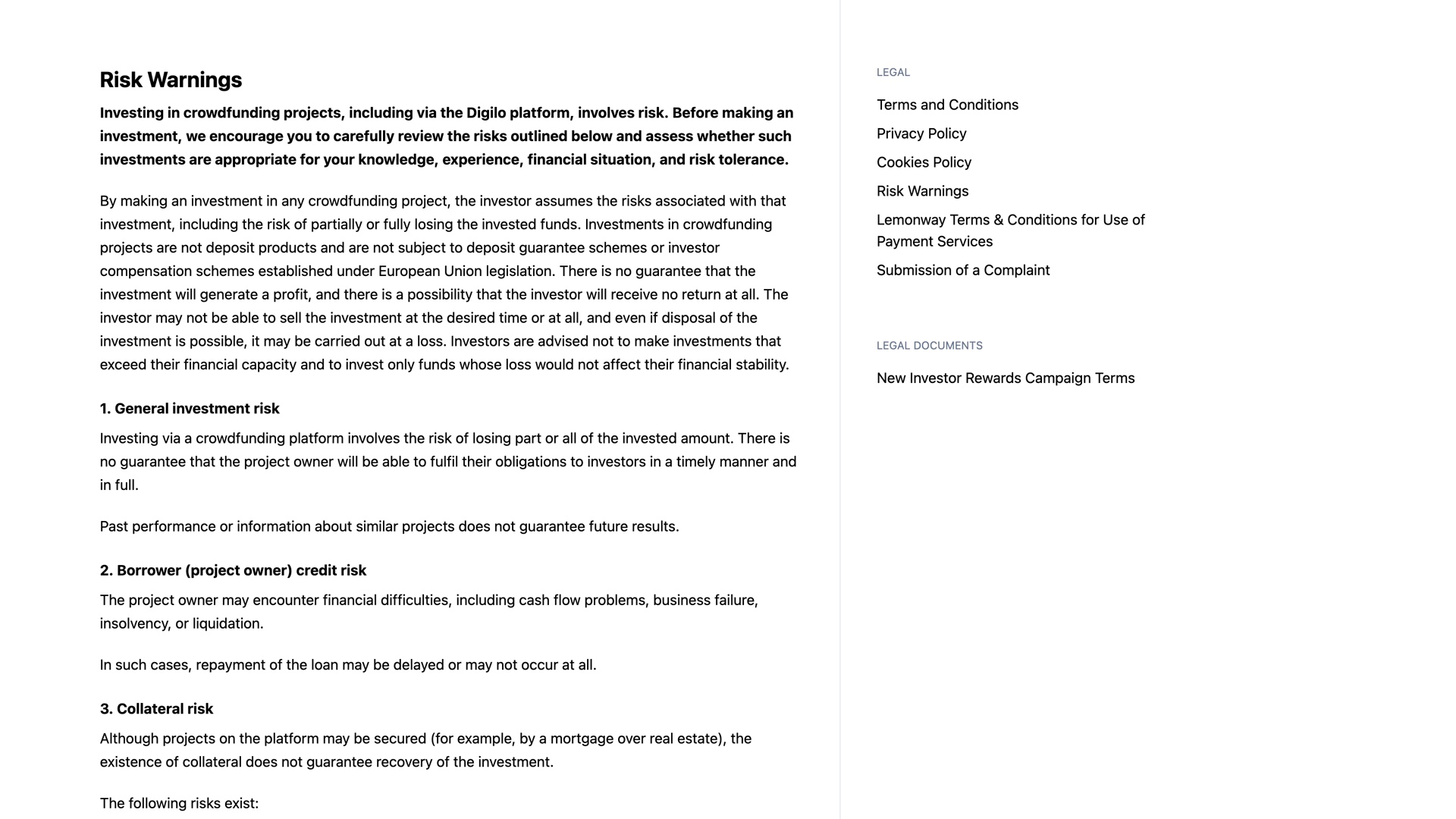
The platform correctly distinguishes regulation and collateral from a guarantee of capital or returns.
The most important risks are borrower default, delayed collateral enforcement, an insufficient recovery price, illiquidity, platform disruption and concentration in a small number of projects or regions.
Auto-Invest and portfolio construction
Digilo's terms describe two Auto-Invest approaches:
- Set & Forget: automatic investment in eligible new projects, with a stated €150 minimum.
- Select & Maximize: more detailed filters for LTV, interest, term, geography and collateral type, with a stated €300 minimum.
Auto-Invest is useful when a marketplace has enough supply to diversify and when the filters reflect a clear risk policy. It is less useful if it turns every available loan into an automatic purchase.
I would cap the amount allocated to one project, avoid relying on a single property type or borrower profile, and review the account regularly. Automation should implement a portfolio policy, not replace due diligence.
What I like
The strongest part of Digilo is how coherent the proposition is. It has a narrow focus, relevant regulation and enough visible project data to support an informed first screen.

Digilo positions itself around real-estate-secured lending in Latvia and the wider EU rather than trying to cover every P2P asset class.
The points I particularly like are:
- Regulation: ECSP authorisation is a stronger starting point than an unregulated marketplace structure.
- Collateral: every project is designed around tangible property security.
- Clear LTV disclosure: the marketplace makes leverage visible before investors open a project.
- Accessible diversification: €150 is a practical entry point for testing the platform.
- Relevant team background: the stated lending and real-estate history predates the public marketplace.
- Useful filters: investors can screen by risk, LTV, term and rate.

The overall offer combines an experienced team, accessible minimum, project metrics and an EU-regulated structure.
What to keep in mind
The main limitation is time. Digilo received its authorisation in September 2025 and is still building the public history investors need to judge repayment performance, arrears, recoveries and withdrawal execution across a full credit cycle.
Project supply also matters. A €150 minimum helps diversification only when enough suitable loans are available. I would rather hold cash than weaken my criteria merely to remain fully invested.
Finally, these are illiquid private loans. Digilo's terms allow for a bulletin-board function, but investors should not assume they can exit immediately or at face value. I would invest only money that can remain committed until the scheduled maturity and, if necessary, through a recovery process.
Who Digilo is for
Digilo makes the most sense for a European investor who:
- wants a small allocation to property-backed private credit;
- understands that a 9–12% target return comes with real credit risk;
- is comfortable reviewing loan and collateral documents;
- can hold investments for 12–36 months or longer if recovery is required;
- will diversify across projects and keep crowdfunding as one part of a broader portfolio.
It is not a replacement for emergency savings, cash reserves, a diversified ETF portfolio or a guaranteed fixed-term deposit. I see it as a satellite holding: potentially useful for income and diversification, but deliberately limited in size.
Pros and cons
What works well
- Authorised under the EU crowdfunding framework and supervised by Latvijas Banka
- Real-estate collateral is central to every listed project
- Clear display of amount, LTV, interest, term, risk and funding progress
- €150 minimum makes gradual diversification practical
- Team presents a long background in real estate and secured lending
- Lemonway handles regulated payment services and identity verification
- Auto-Invest supports both simple and more selective strategies
What to consider
- Public repayment and recovery history is still developing
- Investments are illiquid and may run beyond their scheduled term
- Property collateral does not guarantee full or timely recovery
- Balloon repayments concentrate refinancing risk at maturity
- Diversification depends on the volume and variety of live projects
- Crowdfunding losses are not covered by deposit-guarantee or investor-compensation schemes
FAQ
Is Digilo regulated?+
What is the minimum investment on Digilo?+
What returns does Digilo offer?+
Are Digilo investments guaranteed?+
What is the maximum LTV on Digilo?+
Does Digilo offer Auto-Invest?+
What happens if a borrower defaults?+
Verdict
Digilo has a credible foundation for a young crowdfunding platform. The ECSP authorisation is real, the real-estate security model is easy to understand, the stated maximum LTV is reasonably conservative, and the marketplace exposes the core numbers investors need to compare projects.
I also like the team's stated background in secured lending. It gives Digilo more substance than a new marketplace built by a team with no visible credit experience.
The missing ingredient is a longer public record. I want to see a larger pool of completed projects, on-time repayments, transparent arrears statistics, recovery cases and smooth withdrawals. Those results can only be produced over time.
My view is therefore positive, with measured position sizing. I would begin with the €150 minimum, diversify across several projects, examine every collateral package and increase the allocation only after seeing the platform perform in practice. Used that way, Digilo can be an interesting addition to a diversified European P2P and real-estate crowdfunding portfolio.
Explore Digilo

Thanks for reading.
Explore more of my experience with investing and building passive income.
Inside my portfolioKeep reading
A prelaunch look at Unitoq's €100 starting amount, rental income and ownership model, its Riga-first focus, and the licensing, fees and risks to understand.
LEI System’s prices, application and renewal terms, with a practical look at which plan suits your company.
How litigation funding works, what the public track record shows, and the fees, minimum investment, and risks to understand before committing money.
Compare plans, currency tools, team cards, and integrations, with a closer look at the charges European businesses need to factor into their decision.
Explore the loan types, governance, target returns, and loyalty programme, alongside the uncertainties that come with investing through a newer lending platform.
My experience with Romanian property lending, covering collateral, minimum investment, investor fees, target returns, and the risks behind the platform’s projects.