Platform review
Qasa Review: Rental Income and Property Ownership
A pre-launch look at the planned €100 minimum, European property model, investor rights and the licensing and risks to understand before investing.
This is an unpaid, pre-launch introduction based on Qasa's public information and supplied materials. I have not invested through the platform or reviewed personal investment results. Qasa does not currently offer investments; joining its waitlist is not a commitment to invest.
The short version
Qasa at a glance
- The ideaParticipate in the economics of existing European rental properties through a property-holding company, rather than lending money to a developer.
- Planned starting amount€100, with investors receiving their proportionate share of rental income and any sale proceeds, net of fees, expenses and the investment's actual terms.
- Who does the workProfessional partners would handle tenants, maintenance and day-to-day property management. That does not remove vacancies, costs or property risk.
- Current statusPre-launch. Qasa says EU ECSP authorisation is in progress. The team's Q1 2027 target is conditional on approval, not a guaranteed launch date.
- My starting pointAn interesting model to follow, not a tested investment recommendation. I would check the licence, legal rights, property documents, full fees and exit arrangements before committing money.
I like the basic idea behind a rental property: tenants pay rent, the owner receives income after expenses, and the property may eventually be sold. Turning that idea into an investment takes considerably more work than the description suggests.
Buying an entire property can require substantial savings, financing and transaction costs. Once you own it, you also need to find tenants, arrange repairs, handle administration and manage periods when the property is empty.
Qasa is preparing a platform intended to make participation in rental property more accessible. Its planned model combines a €100 minimum with ready-to-let European properties and professional management.
The distinction I find worth exploring is the type of investment. Qasa describes an ownership interest in the company holding a property, with a proportionate share of rental income and potential sale proceeds. That is different from earning interest by lending money to a property developer.
The platform has not launched yet. According to the team, launch is targeted for Q1 2027, subject to regulatory approval. For now, its waitlist is a way to follow the project, not to place an investment.

Who this review is for
This introduction is for someone who likes the idea of rental income but does not want to buy and manage an entire apartment. It may also interest readers comparing property ownership with the loan-based investments I cover elsewhere on the site.
One challenge with buying a whole property is the size of the initial commitment. Even a relatively modest apartment can represent a large proportion of an investor's savings. If most of your property budget goes into one apartment, your results depend heavily on its location, condition, tenant demand and running costs.
There is also the practical side: decisions about tenants, maintenance, insurance and management. Hiring a manager can help, but the owner still needs to understand the costs and responsibilities involved.
Qasa's proposition addresses those barriers by allowing smaller investments and delegating daily management. While a lower entry point can make diversification easier, it does not turn an illiquid property investment into a cash account.
For the wider context, my real estate crowdfunding guide explains why property ownership and property lending deserve separate analysis.
What Qasa is building
Qasa is developing a digital platform focused on ready-to-let properties in Europe. The emphasis is on existing properties suitable for generating rental income, rather than financing construction projects.
According to the team's supplied description, investors would be able to browse selected opportunities after launch and choose the properties in which they want to participate. Each property would be acquired through a dedicated company, often called a special purpose vehicle, or SPV. Investors would become shareholders in that company in proportion to their investment.
That ownership structure matters. Rather than having your name directly on the title of a small part of an apartment, you would hold shares in the company that owns it. Your rights to income, decisions about the property and eventual sale proceeds would depend on the legal documents and terms of the investment.
Qasa's public FAQ confirms that properties are intended to be held in dedicated legal structures and managed by professional partners. I would still want to read the actual share terms and property documents before treating a particular opportunity as equivalent to direct ownership.
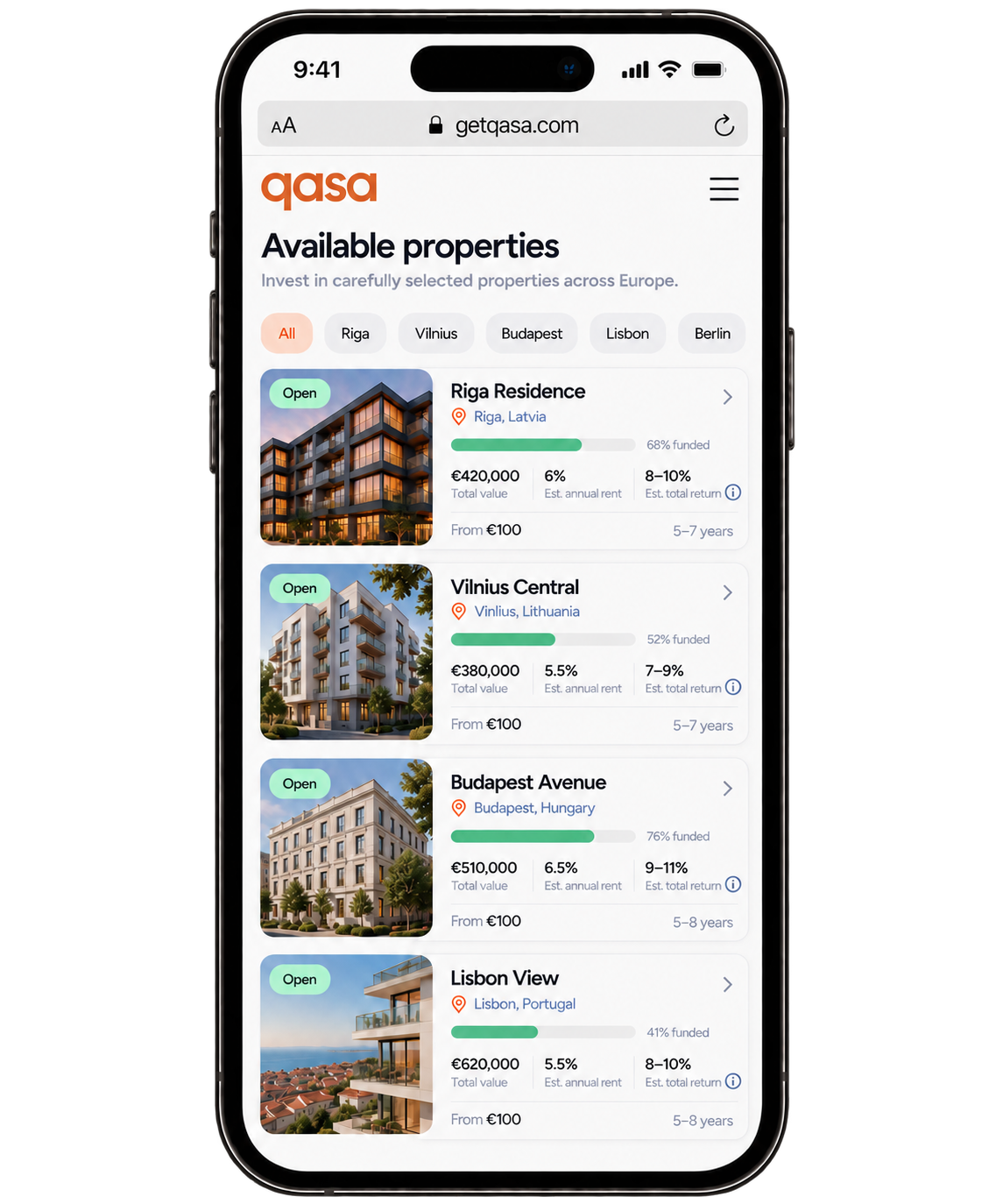
Property ownership versus property lending
Real estate investing can mean several different things. Lending money for a project and owning an interest in a rental property both involve real estate, but they give investors different rights and sources of return.
With a standard property loan, the investor is a lender. The expected return comes from interest and repayment under the loan agreement. A rise in the property's value does not automatically give that lender a share of the gain. Some agreements can include additional participation, so the actual contract remains the reference.
Qasa's planned approach is based on an ownership interest. Investors would hold shares in the company owning the property, connecting their investment to both rental performance and eventual sale value.
| Question | A conventional property loan | Qasa's proposed ownership model |
|---|---|---|
| What do you hold? | A contractual lending claim | Shares in a property-holding company, subject to the final documents |
| Where could income come from? | Contractual interest | A proportionate share of distributable rental income |
| Do you participate in property value growth? | Not automatically; check the loan agreement | Potentially, through the investment's share of sale proceeds |
| What can go wrong? | Borrower default, delayed repayments and inadequate recoveries | Vacancies, expenses, falling property values and an unfavourable sale |
| Can you exit on demand? | Not necessarily | Not established; check the final exit arrangements |
According to Qasa, investors would receive their full proportionate share of rental income net of fees and expenses, together with their share of any increase in value when the property is sold, subject to the investment terms.
This is exposure to ownership economics, not a guaranteed interest rate. Investors would share in downside risk as well as potential gains.
Rental income and potential capital gains
The proposed model has two potential sources of return: rental income during the investment period and proceeds from the eventual sale of the property.
For rental income, investors would receive their proportionate share of the amount available for distribution after applicable fees and property costs. Someone holding 1% of a property-owning company might generally expect a corresponding share of its distributable income, subject to the terms. That does not mean receiving 1% of gross rent: management expenses, maintenance and other costs need to be accounted for first.
The second potential source comes when the property is sold. If its value has increased, investors could benefit through their share of the sale proceeds. If its value has fallen, transaction costs or other liabilities could reduce the amount returned. Neither rental income nor capital appreciation is guaranteed.
Qasa's public calculator is useful for understanding the assumptions behind its example. It is not evidence of actual investment performance.
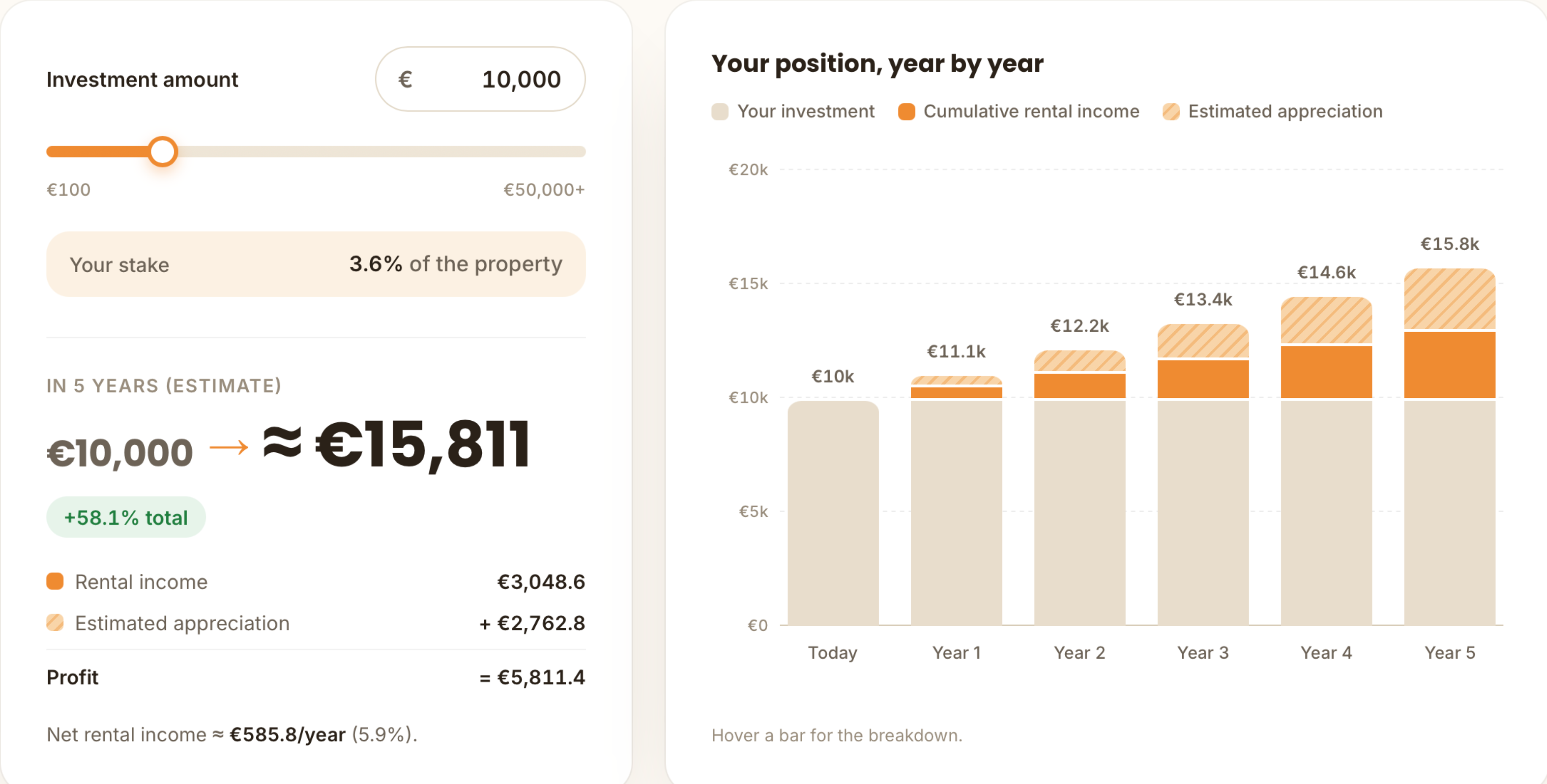
The screenshot combines estimated property value growth with cumulative rental income. The displayed €15,811 is an illustrative combined outcome, not a guaranteed account balance, a realised return or money necessarily available to withdraw after five years.
I would look closely at the assumptions: the purchase valuation, initial rental income, vacancies, repairs, management fees, sale costs and taxes. A small change in occupancy or the eventual sale price can materially change the result.
Property management without becoming the landlord
A central part of Qasa's proposition is professional management. Investors would participate financially while appointed managers handle the operational work. Its public materials describe responsibilities covering tenants, maintenance and daily operations.
That could suit people who want property exposure without organising repairs or dealing with tenant administration themselves. While delegating management can make participation more convenient, the quality of the manager and the fees charged still affect the investment.
I would want to know who appoints the manager, how performance is monitored, what happens if a manager needs to be replaced, and which expenses can be charged to the property company.
An existing rental property avoids funding a building site. It does not remove the possibility of major repairs, empty periods, unexpected costs or weak tenant demand.
Starting with €100 and diversifying over time
Qasa's planned €100 minimum is one of its most accessible features. It would allow investors to consider opportunities with a smaller initial commitment, although the actual minimum should be checked once offerings are available.
As more properties become available, that entry point could make it easier to spread a budget across several opportunities instead of putting the full amount into one apartment. This is a general illustration of diversification, not a description of a portfolio currently available on Qasa.
The team's stated ambition is to offer properties across multiple European locations within the EU. Its selection approach focuses on markets it considers undervalued, with growth potential and established regulation. Those are selection criteria, not a guarantee that prices will rise.
That ambition is worth distinguishing from the launch portfolio. The countries, properties and terms available will depend on what the platform actually brings to market. Several properties can also be affected by the same interest-rate changes, economic conditions or rental-market pressures.
Where the licensing process stands
Qasa's public site says authorisation under the EU European Crowdfunding Service Providers Regulation, Regulation (EU) 2020/1503, is in progress. It currently accepts registrations of interest, not investments.
The team's supplied launch target is Q1 2027, conditional on approval. Qasa says it will launch only once authorisation has been granted. An application for a licence is not the same as holding one.
The ESMA registers are a starting point for checking authorised providers. Company registration, a well-designed website and an application in progress do not establish financial-services authorisation.
Licensing is also separate from investment performance. It is not a guarantee that a property will generate income, appreciate in value or be sold at a favourable price.
Fees, investor rights and exit arrangements
Before committing money, I would want to understand:
- Ownership and voting rights: what the shares represent, how decisions are made and how investors are treated if the property company encounters difficulties.
- Fees and expenses: which costs apply when investing, during ownership and when the property is sold. Qasa says these will be disclosed in the investment's Key Investment Information Sheet (KIIS).
- Rental assumptions: whether projections account for vacancies, repairs, insurance, management expenses and local taxes.
- Investment duration: the expected holding period, who decides when to sell and whether investors can influence that decision.
- Exit arrangements: whether shares can be sold before the property is sold, on what terms and with what evidence of actual buyer demand.
- Property information: its location, condition, valuation and the evidence supporting the investment case.
The complete investment fees, tax treatment, share rights and practical exit options should be assessed against the actual offering documents after launch. I would not invent a fee schedule or assume a secondary market from a prototype.
Property investments can be difficult to sell quickly. I would avoid assuming that money committed through the platform could be withdrawn on demand, and I would check the reporting implications for my country of residence.
Alternatives and the wider context
Qasa is not an available investment yet, so this is a comparison of models rather than a recommendation to switch money into it.
My real estate crowdfunding guide explains the difference between ownership and lending exposure. The European real estate crowdfunding comparison covers other platforms and their different structures and risks. My P2P lending guide is the relevant starting point if you are comparing Qasa's proposed ownership model with lending claims.
For me, the important choice comes before the platform name: do I want contractual lending exposure or a share of property income and sale value, and how much liquidity can I give up?
Pros and cons of the proposed model
What works well
- Planned €100 starting amount could make smaller allocations possible
- Participation in rental income and potential property value growth
- Focus on existing, ready-to-let properties rather than construction financing
- Professional partners would handle daily property management
- Potential to diversify across properties as the available range develops
What to consider
- Pre-launch platform: authorisation has not yet been established as granted
- No personal investment experience or operating performance history assessed here
- Final fees, investor rights and exit terms need to be checked in actual offering documents
- Rental income, property values and sale proceeds are not guaranteed
- Professional management and smaller allocations do not remove illiquidity or capital-loss risk
FAQ
Is Qasa live and accepting investments?+
What is the planned minimum investment?+
Would I directly own part of an apartment?+
How could investors receive income?+
Can I rely on the calculator's projected return?+
Could I sell my investment whenever I want?+
My initial thoughts and the waitlist
What interests me about Qasa is the combination of a smaller entry point, ready-to-let properties and professional management, together with participation in rental income and potential capital gains.
The clearest way to describe the proposed model is accessible property-ownership economics through a property-holding company. For someone who likes the idea of rental investing but does not want to buy and manage an entire apartment, that could be a useful model to explore.
At this stage, though, this is an introduction to a planned platform, not a review of my investment results. My assessment of any future opportunity would depend on the authorisation, legal documents, costs and underlying property. I would not allocate money simply because a calculator shows an attractive outcome.
For now, joining the waitlist is the simplest way to follow the project. According to Qasa, signing up is free, involves no commitment to invest, and provides launch updates, early access and special offers for founding members.
Free registration of interest. No commitment to invest. Future investment opportunities depend on authorisation.
This introduction is for information only and is not a personal investment recommendation, legal advice or an offer to invest. Future investments involve risk, including loss of capital. Rental income and property values can fall, and investments may be difficult to sell. Calculator figures are illustrative estimates, not guaranteed returns.

Thanks for reading.
Explore more of my experience with investing and building passive income.
Inside my portfolioKeep reading
LEI System’s prices, application and renewal terms, with a practical look at which plan suits your company.
How litigation funding works, what the public track record shows, and the fees, minimum investment, and risks to understand before committing money.
Compare plans, currency tools, team cards, and integrations, with a closer look at the charges European businesses need to factor into their decision.
A closer look at mortgage-backed projects, target returns, minimum investment, regulation, and the risks involved in lending through this real estate platform.
Explore the loan types, governance, target returns, and loyalty programme, alongside the uncertainties that come with investing through a newer lending platform.
My experience with Romanian property lending, covering collateral, minimum investment, investor fees, target returns, and the risks behind the platform’s projects.