Platform review
Unitoq Review: Rental Property Ownership from €100
A prelaunch look at Unitoq's €100 starting amount, rental income and ownership model, its Riga-first focus, and the licensing, fees and risks to understand.
Most property lending platforms pay you interest. Unitoq's proposed model is different: participate in rental income and potential property value growth through an ownership interest. Here's how it would work—and what to understand before investing.
Disclosure: This is an unpaid introduction, not an affiliate promotion. I have not invested through Unitoq. This article updates my earlier introduction to the project under the Qasa name.
Lending to a property project is not the same as owning it
Imagine lending money to a property project. Over the following years, the neighbourhood becomes more desirable and the property's value rises considerably.
Does that mean your investment benefits from the increase?
Not necessarily. If your agreement pays a fixed interest rate, that is generally what you receive, assuming the borrower repays. The property owner keeps the remaining upside.
There is nothing inherently wrong with that arrangement. Lending and ownership simply offer different rights, risks and potential returns.
But if your reason for investing in real estate is to receive rent and participate in rising property values, the distinction matters. My real estate crowdfunding guide explains the wider difference between these models.
That is what interests me about Unitoq.
Its proposed model is closer to the economics of owning a rental apartment: investors would participate in rental income and eventual sale proceeds, rather than simply earning interest on a loan.
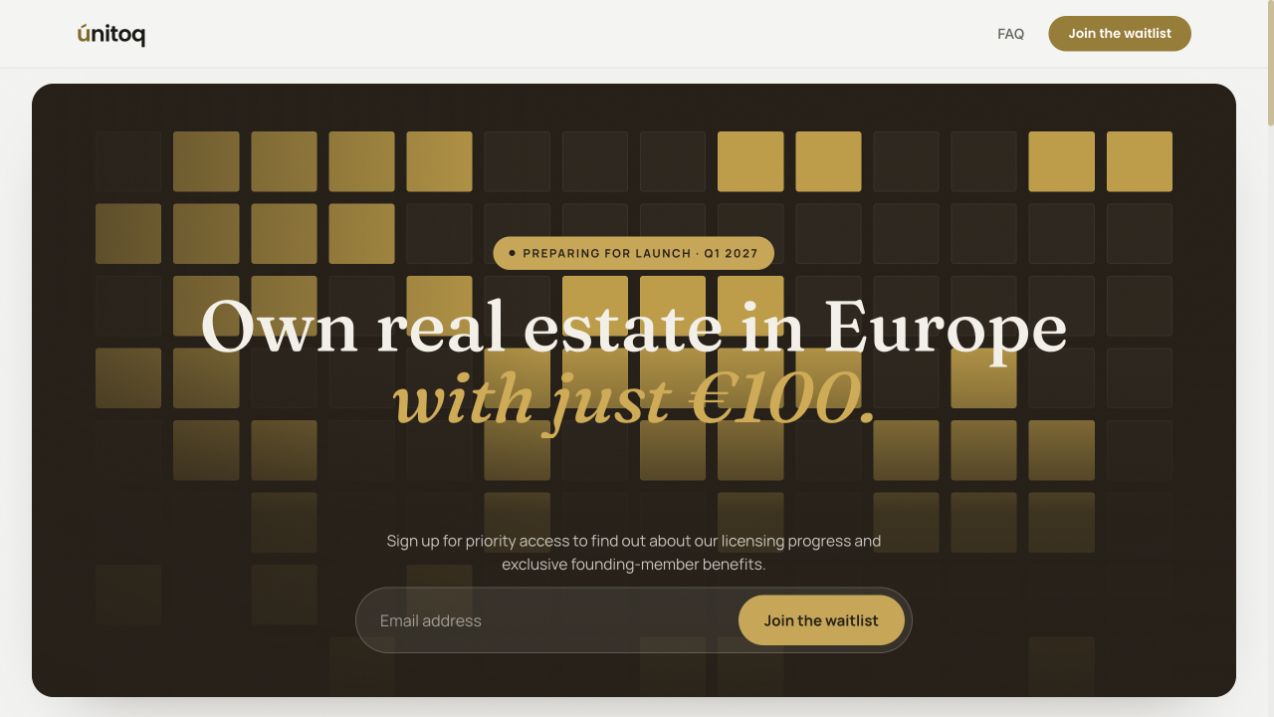
The platform is not open for investment yet. For now, you can visit Unitoq and join its waitlist.
What is Unitoq?
Unitoq is a planned European real estate investment platform with a starting amount of €100.
The idea is straightforward: make it possible to participate in rental properties without buying an entire apartment or managing tenants yourself.
Its new website identifies Riga as the initial focus, within a wider European ambition. That is a more useful starting point than assuming a large international portfolio will be available immediately.
An important qualification comes first: this is a prelaunch introduction, not a review of an operating investment account or realised returns. Features and investment terms may change before launch.
How would ownership work?
You would not have your name directly registered as the owner of a small section of an apartment.
Instead, Unitoq describes a company-based structure.
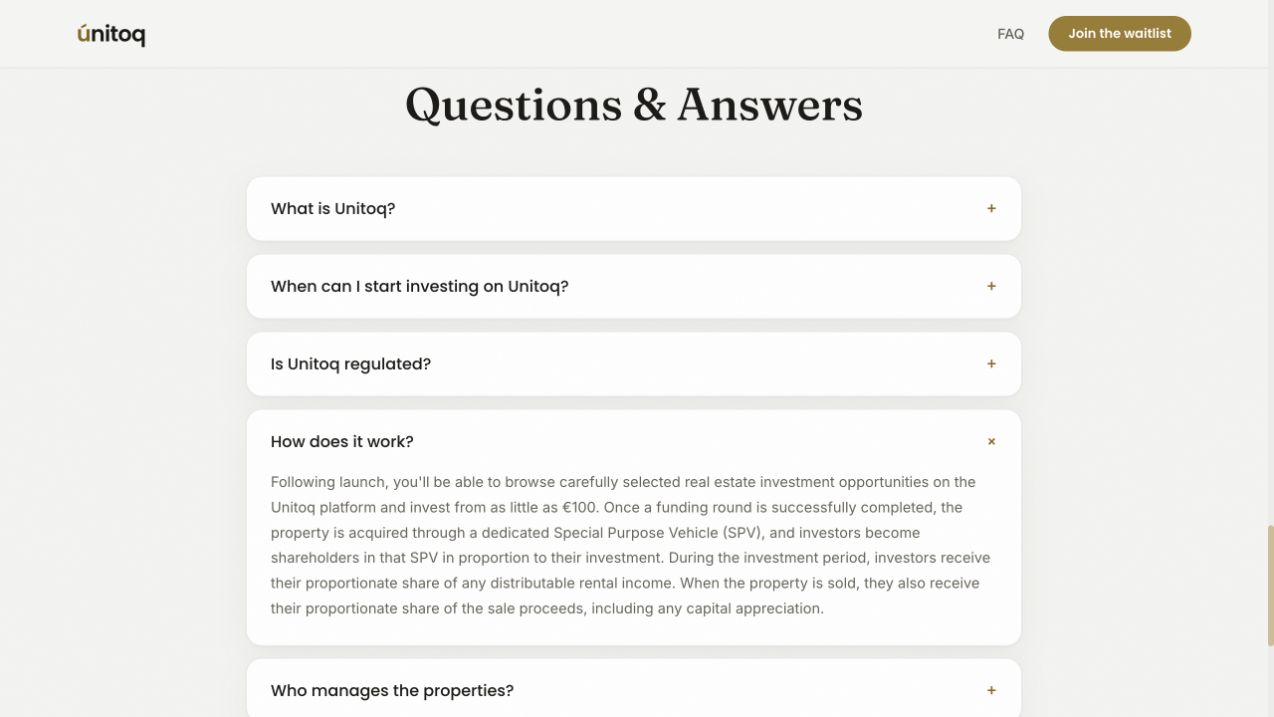
After a funding round successfully completes, a dedicated company—called a special purpose vehicle, or SPV—would acquire the property. Investors would become shareholders in that company in proportion to their investment.
That distinction is important:
- The SPV owns the property.
- You own shares in the SPV.
- Your financial and voting rights depend on the investment documents.
During ownership, investors would receive their proportionate share of any distributable rental income. When the property is sold, they would receive their share of the sale proceeds, after applicable costs and liabilities.
In other words, your outcome would be linked to the property's actual performance, not a fixed interest promise. This structure is described in Unitoq's public FAQ.
Two potential sources of return
The proposed model combines rental income with potential capital appreciation.
Rental income is the money available for distribution after expenses. Tenants pay rent, but management, maintenance, insurance and other property costs must be accounted for before investors receive their share.
Capital appreciation comes into play when the property is sold. If the sale produces a profit after costs, investors could benefit proportionately. If the property loses value, they share that downside too.
The attraction is participation in both sources of return. It is not a guarantee that either will be positive.
A €1,000 example: what ownership economics could look like
Here is a simplified illustration using the assumptions in the supplied materials—not a current Unitoq offer or a forecast.
Assume:
- An apartment costs €200,000.
- You invest €1,000, representing a 0.5% economic interest.
- Gross annual rent stays at €12,000: 6% of the purchase price.
- The property appreciates by 6% annually and is sold after five years.
- For simplicity, the calculation excludes all fees, expenses and taxes.
| Illustration | Whole property | Your 0.5% share |
|---|---|---|
| Purchase price / investment | €200,000 | €1,000 |
| Gross rent per year | €12,000 | €60 |
| Gross rent over five years | €60,000 | €300 |
| Sale value after five years | €267,645 | €1,338 |
| Gain on the property's value | €67,645 | €338 |
| Total profit before costs, fees and taxes | €127,645 | €638 |
| Total gross return over five years | 63.8% | 63.8% |
Rounded figures. This assumes full rent collection, no vacancies, constant annual gross rent and 6% annual property appreciation. Actual results could be substantially lower or negative.
The €638 is profit, not the total amount returned. In this illustration, your original €1,000 plus rent and sale proceeds would amount to approximately €1,638 before deductions.
The point is not that investors should expect this result. It is that ownership connects your outcome to both rent and the sale value.
Property costs, platform fees, purchase and sale expenses, taxes and any borrowing within the structure would change the calculation. The final investment documents must explain these.
Start with €100 instead of buying an entire apartment
Buying a rental apartment directly can mean committing a large sum to one building, one neighbourhood and often one tenant.
There are also transaction costs, financing decisions and the practical work of completing the purchase.
A smaller entry point could make it easier to build exposure gradually and spread a budget across several properties as opportunities become available.
That is the appeal of Unitoq's planned €100 starting amount.
However, smaller investments do not automatically create diversification. Several properties in the same city can still be affected by the same economic conditions.
I would look at the actual opportunities, locations and costs—not just the minimum investment.
Why start with Riga?
Unitoq's new site puts Riga at the centre of its initial strategy.
The company describes a focus on markets it considers undervalued and capable of growth. That is a selection approach, not proof that any particular property is inexpensive or likely to appreciate.
For me, the useful questions would be property-specific:
What supports the purchase valuation? Is the rent realistic? What is the building's condition? How strong is tenant demand? What repairs might be needed?
A city-level yield comparison can provide context, but it cannot replace an assessment of the apartment being purchased.

Existing properties, with professional management
The supplied materials emphasise ready-to-let properties rather than construction financing.
That is an important distinction. Buying an existing rental property avoids some risks associated with funding a building project, such as construction delays and cost overruns.
It does not make the investment risk-free.
An existing apartment can still remain empty, need expensive repairs or attract less rent than expected. "Ready to let" should not be read as a guarantee of income from the first day.
Professional management is intended to remove the everyday landlord workload. You would not personally handle tenant calls, arrange routine repairs or chase rent payments.
That convenience has value, but the manager's competence and fees still affect what investors ultimately receive.
Who is behind the project?
The team's supplied background describes more than 13 years of real estate investment experience, alongside experience running international businesses.
That provides context, but it is different from an operating track record for this platform.
Before investing, I would want to understand who selects the properties, which projects demonstrate their experience, how valuations are checked, and how investors' interests are represented when important decisions arise.
Is Unitoq regulated yet?
Not yet, according to its published information.
Unitoq says it is pursuing an ECSP crowdfunding licence from the Bank of Latvia. Its target launch is Q1 2027, subject to regulatory approval.
The company's privacy policy and website disclaimer explicitly state that it is not currently authorised to provide crowdfunding or investment services.
An application is not an approval. The Bank of Latvia explains that crowdfunding providers require authorisation under the applicable framework.
Before investing after launch, I would check the authorisation, the permitted services and the documents for the specific opportunity.
Regulation is also separate from investment performance: it does not guarantee rental income, a profitable sale or repayment of your capital.
The risks I would keep in mind
Property values can fall. Ownership gives you exposure to losses as well as gains.
Rent is not guaranteed. Vacancies, unpaid rent and unexpected repairs can reduce or eliminate distributions.
Fees matter. A gross illustration is not an investor's net return. Purchase, management, platform and exit costs need to be understood.
Your money may be tied up. Do not assume you can sell shares or withdraw money whenever you want.
The structure matters. Shareholder rights, decision-making, any property-level borrowing and arrangements if the platform stops operating all deserve attention.
Concentration remains a risk. Several small investments can still depend on the same city or property market.
Currency exposure may arise. If future opportunities involve non-euro assets, exchange rates could affect returns measured in euros.
These are reasons to examine the terms carefully, not reasons to dismiss ownership as a model. My European real estate crowdfunding comparison provides context on other platforms and their different structures.
My initial thoughts on Unitoq
What interests me is the combination of a smaller entry point, professional property management and participation in rental income and potential capital gains.
For someone who likes rental property but does not want to purchase and manage an entire apartment, that is a model worth understanding.
The distinction from lending is real. With ownership, you participate in the property's economics rather than simply receiving contractual interest.
Neither model is automatically better. They offer different rights and expose you to different risks.
At this stage, Unitoq belongs on my list of platforms to follow—not in a comparison of my realised investment results. The meaningful assessment comes when there are authorised services, actual properties and complete investment documents to examine.
Join the Unitoq waitlist
For now, the available action is joining the prelaunch waitlist.
It is a way to receive progress updates and information about the intended launch, without committing to invest. Unitoq's published policy makes clear that joining does not reserve an investment or guarantee access.
If the ownership model interests you, you can follow its progress here:
Prelaunch registration of interest. No commitment to invest or guaranteed access. Authorisation is pending.
This article is for information only, not investment advice or an offer to invest. Unitoq is prelaunch and says authorisation is pending. Future investments may involve partial or total loss of capital. Rental income, appreciation and liquidity are not guaranteed. The numerical example is illustrative and excludes costs, fees and taxes.

Thanks for reading.
Explore more of my experience with investing and building passive income.
Inside my portfolioKeep reading
LEI System’s prices, application and renewal terms, with a practical look at which plan suits your company.
How litigation funding works, what the public track record shows, and the fees, minimum investment, and risks to understand before committing money.
Compare plans, currency tools, team cards, and integrations, with a closer look at the charges European businesses need to factor into their decision.
A closer look at mortgage-backed projects, target returns, minimum investment, regulation, and the risks involved in lending through this real estate platform.
Explore the loan types, governance, target returns, and loyalty programme, alongside the uncertainties that come with investing through a newer lending platform.
My experience with Romanian property lending, covering collateral, minimum investment, investor fees, target returns, and the risks behind the platform’s projects.